
If Legionella has been detected in a water system in Cyprus, the next step is to understand where it was found and determine the appropriate corrective treatment. Depending on the findings, WaterFilterNet can discuss corrective work such as water tank cleaning and disinfection, pipework disinfection, flushing and treatment of relevant parts of the water system., this may involve cleaning and disinfection, flushing, addressing stagnant water or sediment, and correcting conditions that can allow Legionella to persist or return.
Treating Legionella is not always as simple as disinfecting a water storage tank. A positive result from a tank, shower, tap or other outlet can indicate different problems within the system. The laboratory report, sampling locations and condition of the water system should therefore be considered before deciding what treatment is appropriate.
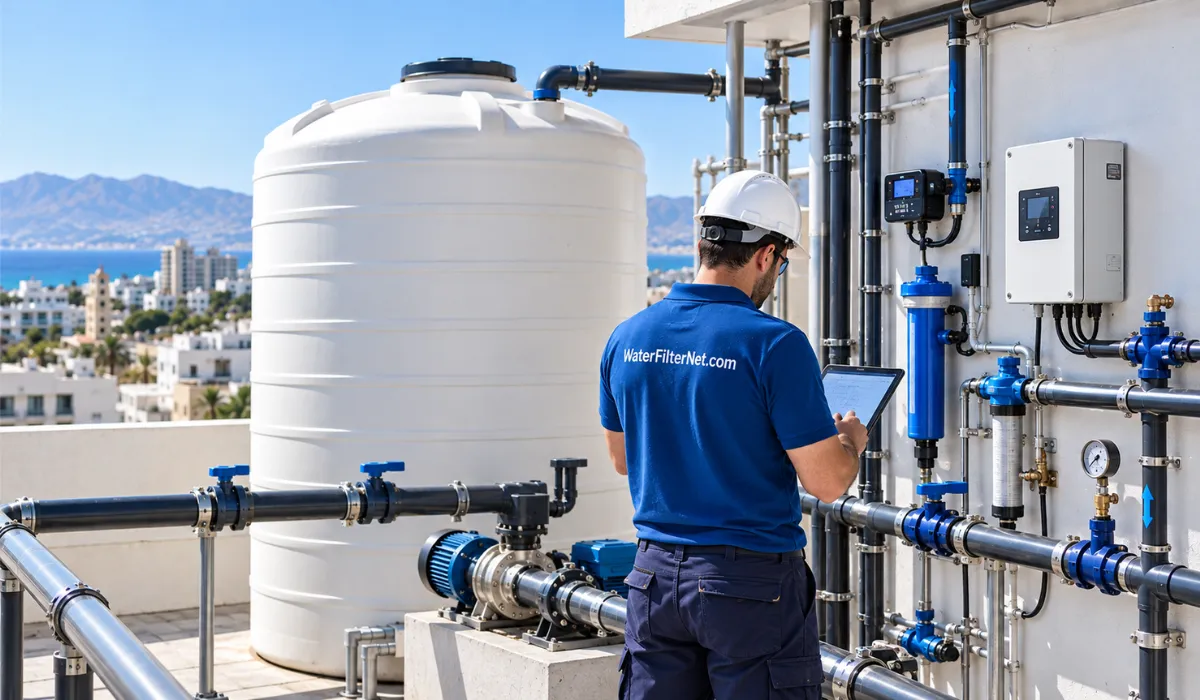
What should you do if Legionella is found in your water system?
If Legionella is detected, the laboratory report and sampling locations should be reviewed first, followed by an assessment of the relevant parts of the water system before deciding on corrective treatment. The appropriate action depends on where Legionella was found, the condition of the system and the factors that may be allowing the bacteria to grow or persist.
- Identify where Legionella was detected. A result from a water tank, shower, tap or other outlet represents a particular sampling point within the system.
- Investigate contributing conditions. Stagnant water, temperature, sediment, biofilm and the condition of tanks, pipework and outlets may all be relevant.
- Apply appropriate corrective measures. Depending on the findings, this may include cleaning and disinfection, flushing, corrective maintenance and addressing conditions that favour Legionella growth.
- Verify the outcome. Field measurements can help monitor treatment conditions, but where confirmation of Legionella is required, appropriate microbiological laboratory analysis is needed.
Have a Positive Legionella Result?
Send us the complete laboratory report and tell us where the samples were taken. We can review the available information about the water system with you and discuss appropriate next steps, including whether further investigation or corrective treatment may be required.
What Does Legionella Treatment Actually Involve?
Legionella treatment involves more than applying a disinfectant. The objective is to address the areas where Legionella has been detected, reduce conditions that may support its growth and take corrective action appropriate to the particular water system.
The correct approach depends on factors such as the laboratory findings, sampling locations, water storage, hot and cold water distribution, stagnant sections of pipework, outlets, sediment, biofilm and the overall condition of the system.
1. Understand the Problem
Review the laboratory results, sampling locations and relevant parts of the water system to understand where corrective action may be needed.
2. Clean Where Required
Sediment, deposits and contamination in tanks or other accessible parts of the system may need to be physically removed before or as part of disinfection.
3. Disinfect the Relevant System
An appropriate disinfection method may be used for the affected tank, pipework or wider water system according to the circumstances.
4. Address Contributing Conditions
Stagnation, unsuitable temperatures, poor water turnover, sediment, problematic outlets or other system conditions may also require attention.
5. Verify After Treatment
Treatment conditions can be checked during the work, while follow-up microbiological laboratory analysis may be appropriate to evaluate Legionella after corrective action.
Why Tank Cleaning Alone May Not Be Enough
A water storage tank can be an important part of a Legionella investigation, particularly where sediment, stagnation or poor tank condition is present. However, Legionella can also be present farther downstream in pipework, showers, taps and low-use outlets.
This means that cleaning and disinfecting a tank does not automatically establish that the entire building water system has been addressed. The corrective treatment should reflect where Legionella was detected and what the wider investigation shows.
Important: There is no single Legionella treatment procedure that is appropriate for every building. The treatment method and extent of the work should reflect the water system, laboratory findings and conditions identified during the investigation.
How Is a Water System Investigated After a Positive Legionella Result?
When Legionella is detected, the first step is to connect the laboratory result to the location where the sample was taken and understand how that point relates to the rest of the water system. This helps determine whether the problem may be localised or whether other parts of the system should also be considered.
The investigation should focus on conditions that can allow Legionella to multiply or persist rather than assuming that every positive result has the same cause.
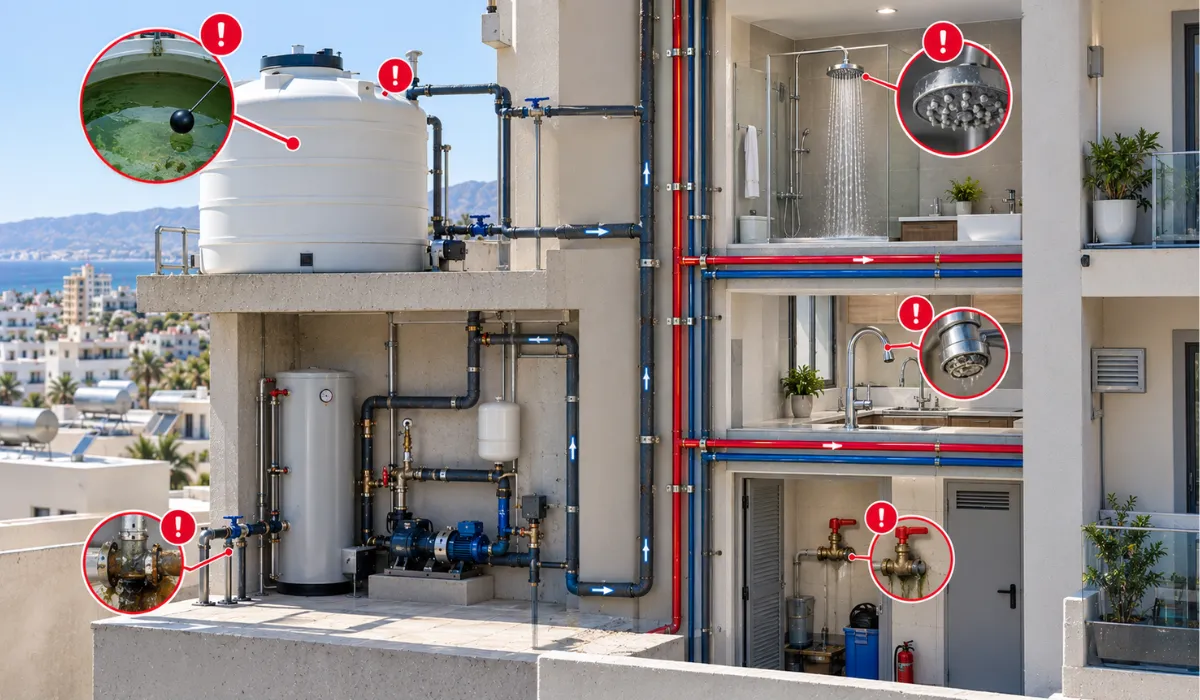
1. Review the Laboratory Report and Sampling Locations
The complete laboratory report should be reviewed together with the sampling information. Important details can include the sampling point, date, result, units, analytical method and whether the sample came from hot or cold water.
Where several samples were analysed, the pattern of results can be particularly useful. For example, a positive result from one low-use shower alongside negative results from other locations raises different questions from positive results detected at several points throughout a building.
2. Understand the Water System
The next step is to understand how water is stored and distributed through the property. Depending on the building, this may include:
- Water storage tanks and their condition
- Hot-water storage and distribution
- Cold-water distribution
- Pipework supplying the affected sampling point
- Showers, taps and other outlets
- Low-use or unused branches of pipework
- Different tanks or water circuits serving different areas
This is particularly important in larger properties where one building may contain several tanks, long pipe runs or areas with very different patterns of water use.
3. Look for Stagnation and Low Water Use
Stagnant or slow-moving water is an important factor to investigate. Rarely used showers, guest bathrooms, vacant rooms, seasonal areas and dead-end or low-use sections of pipework can experience very different conditions from outlets that are used every day.
Where stagnation is identified, treatment should not focus only on disinfection. The underlying cause of poor water movement may also need to be addressed.
4. Check Temperature and Relevant Water Conditions
Water temperature can influence Legionella growth. Cyprus Public Health Services identifies approximately 20°C to 45°C as a favourable temperature range for Legionella multiplication.
Depending on the system, field measurements such as temperature and disinfectant residual can help provide information about conditions at tanks and outlets. These measurements support the investigation, but they do not determine whether Legionella is present or absent.
Important distinction: Temperature, pH, TDS, conductivity and disinfectant-residual measurements can help assess water-system conditions. Legionella itself requires appropriate microbiological laboratory analysis.
5. Inspect Tanks, Sediment, Pipework and Outlets
Physical conditions within the water system may also contribute to the investigation. Depending on the property, relevant observations can include sediment or deposits in storage tanks, tank condition, scale or deposits at outlets, poorly used sections of pipework and the condition of showers and taps.
These findings help determine what corrective work may be appropriate and whether treatment should focus on a particular location or extend to other parts of the water system.
Finding the Likely Problem Area Matters
A positive Legionella result should therefore lead to a simple but important question:
Where was Legionella detected, and what conditions in that part of the water system could be contributing to the result?
Answering that question helps determine whether corrective action should involve a particular outlet, storage tank, section of pipework or a wider part of the building water system.
Cyprus reference:
Cyprus Public Health Services — Legionellosis / Legionnaires’ Disease ↗
How Can Legionella Be Treated in a Water System?
Legionella treatment should be selected according to the water system, laboratory findings and conditions identified during the investigation. There is no single cleaning or disinfection method that is appropriate for every property.
Depending on the situation, corrective treatment may involve a combination of physical cleaning, flushing, disinfection, outlet maintenance, correction of stagnant areas and improvements to the way water is stored or circulated.
Depending on the findings, WaterFilterNet can discuss corrective work such as water tank cleaning and disinfection, pipework disinfection, flushing and treatment of relevant parts of the water system.
Important: Treatment should not focus only on reducing Legionella at the time of disinfection. If the conditions that allowed the bacteria to grow remain unchanged, Legionella may develop again within the water system.
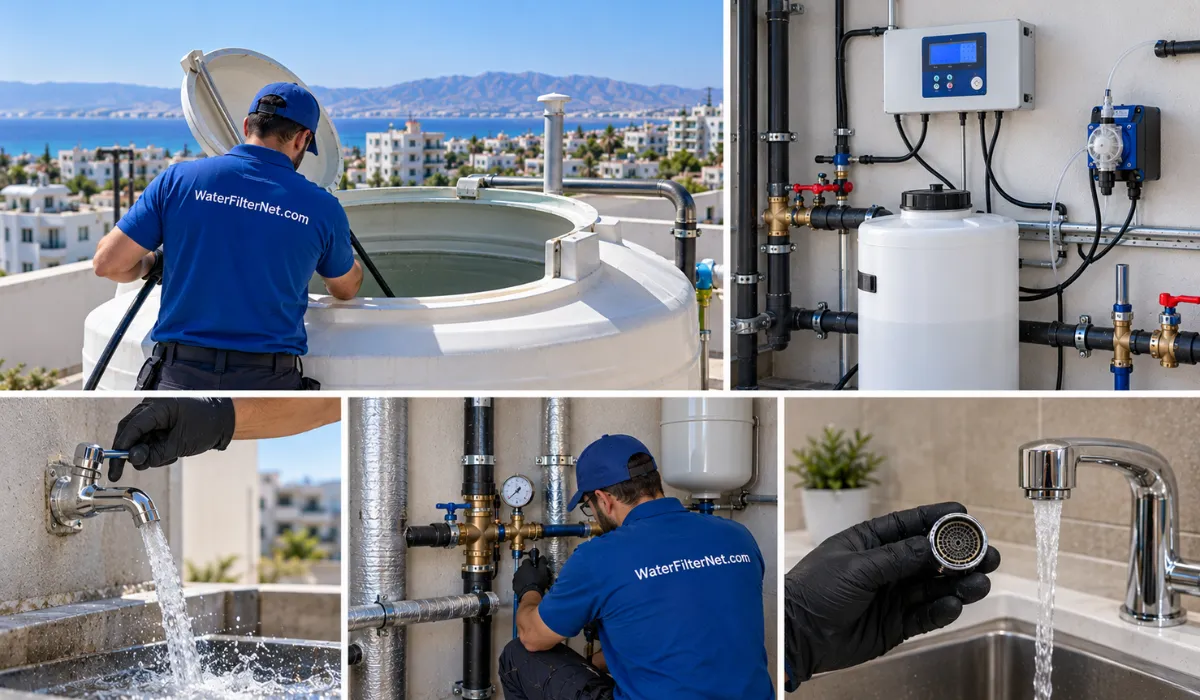
Physical Cleaning and Removal of Sediment
Physical cleaning can be an important part of corrective treatment where tanks or accessible water-system components contain sediment, deposits or visible contamination. These materials can support biofilm and create conditions that make effective water-system control more difficult.
Depending on the system, corrective work may include cleaning water storage tanks, removing accumulated sediment and cleaning or maintaining components such as showerheads, aerators and other outlets.
Cleaning alone, however, should not automatically be assumed to address Legionella throughout the entire system. Pipework and downstream outlets may also require consideration.
Flushing and Restoring Water Movement
Flushing can help replace stagnant water within pipework and restore fresh water to low-use sections of a building. It may be particularly relevant where Legionella concerns are associated with unused outlets, seasonal rooms, vacant areas or sections of pipework with poor water turnover.
For larger systems, flushing may need to be planned in sections so that relevant branches and outlets are properly addressed.
Flushing is not automatically a complete Legionella treatment. Where contamination is established, flushing may form part of the corrective work but should be considered together with cleaning, disinfection and correction of the conditions that allowed Legionella to grow.
Disinfection of Tanks, Pipework and Outlets
Disinfection may be required where Legionella has been detected or where corrective treatment is otherwise indicated. The method should be chosen according to the parts of the system being treated, the materials and equipment present, the water conditions and the intended use of the water.
Depending on the system, treatment may involve a storage tank, selected pipework and outlets, or a wider section of the water distribution system. The objective is to ensure that the corrective treatment reaches the locations that actually require attention rather than assuming that treating one component automatically treats everything downstream.
Can Chlorine Dioxide Be Used for Legionella Treatment?
Chlorine dioxide is one disinfectant that can be used in water-system Legionella control when it is appropriate for the particular application. It should not, however, be presented as the only possible treatment or as a universal solution for every contaminated system.
The concentration, contact conditions, water chemistry, system materials, intended use of the water and applicable product requirements all need to be considered. Where chlorine dioxide is used, the treatment should be carried out and monitored according to the relevant product instructions and technical requirements.
Why the treatment method matters: Chemical disinfection can help control Legionella, but the selected method must suit the actual water system. Inappropriate selection or operation of supplemental disinfection can create ineffective treatment, system damage or unwanted disinfection by-products.
Cleaning and Maintaining Showers, Taps and Other Outlets
Where the investigation identifies concerns at showers, taps, aerators or similar outlets, cleaning, descaling, disinfection or replacement of affected components may form part of the corrective work.
This can be particularly important where deposits or biofilm are present or where an outlet has experienced prolonged low use.
Correcting the Conditions That Allowed Legionella to Grow
Disinfection is only one part of successful Legionella control. Corrective treatment should also consider the conditions that may have contributed to the problem.
Depending on the building, this may include:
- Reducing prolonged stagnation and unnecessary water age
- Improving water turnover in low-use sections
- Managing hot and cold water temperatures appropriately
- Removing sediment and deposits
- Maintaining tanks, showerheads, aerators and other components
- Correcting damaged or poorly maintained water-system components
- Reviewing whether disinfectant control is adequate where applicable
The aim is not simply to disinfect the system once, but to reduce the conditions that could allow Legionella to persist or return.
Technical references:
CDC — Controlling Legionella in Potable Water Systems ↗
ECDC — Legionnaires’ Disease: Protective Measures ↗
What Happens After Legionella Treatment?
After corrective treatment, the outcome should be evaluated rather than assuming that the water system is Legionella-free. What should be checked depends on the treatment performed, the original laboratory findings and the parts of the water system that were affected.
Follow-up Legionella testing in Cyprus may be appropriate after corrective treatment to evaluate Legionella at selected sampling locations.
Verification can involve two different types of information: field measurements that help confirm treatment conditions and follow-up microbiological laboratory testing where this is required to evaluate the result of corrective treatment.
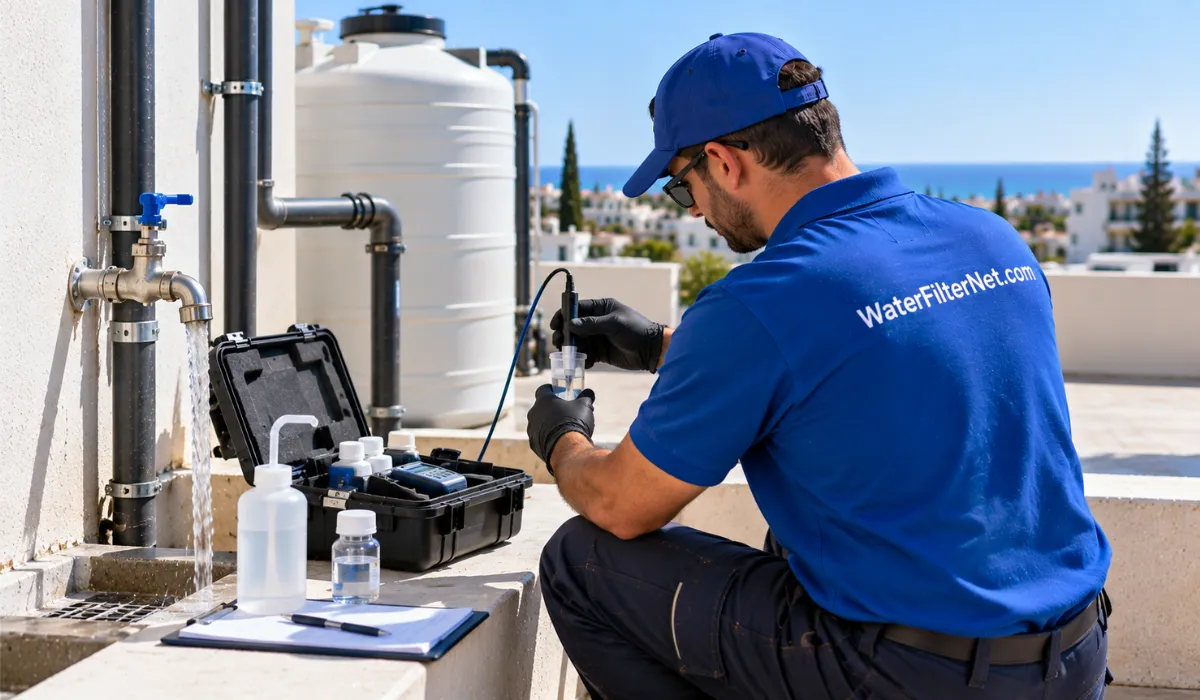
1. Check That the Treatment Was Carried Out as Intended
During and after treatment, relevant operational measurements can help confirm whether the required treatment conditions were achieved at the locations being treated.
Depending on the method used, this may include measurements such as:
- Disinfectant concentration or residual
- Water temperature
- Contact conditions where applicable
- Whether the treatment reached relevant tanks, pipework and outlets
- Whether flushing and other corrective work were completed as planned
Important: A satisfactory disinfectant-residual or temperature measurement does not prove that Legionella is absent. These measurements help verify aspects of the treatment process; they are not microbiological Legionella tests.
2. Consider Follow-Up Legionella Laboratory Testing
Follow-up microbiological testing may be appropriate after corrective treatment to evaluate Legionella at selected sampling locations. The sampling points should reflect the original findings, the areas treated and the purpose of the follow-up investigation.
For example, if Legionella was originally detected at a particular shower, simply testing the storage tank afterwards may not answer whether the original problem location has been addressed. The follow-up sampling strategy should therefore be connected to the original results and corrective work.
3. Choose the Timing and Sampling Points Carefully
There is no single follow-up sampling time or sampling plan that is appropriate for every Legionella treatment. The timing can depend on the treatment method, water system, reason for testing and applicable laboratory or technical guidance.
Sampling immediately after disinfection can answer a different question from testing after the system has returned to normal operation. The purpose of the follow-up testing should therefore be clear before samples are collected.
4. Review the Results in Context
Follow-up laboratory results should be reviewed together with the sampling locations, original results, corrective work performed and current water-system conditions.
A negative result at one location should not automatically be interpreted as proof that every part of a complex building water system is Legionella-free. Likewise, a further positive result may indicate that additional investigation or corrective action is required.
Treatment verification has two different roles:
Field measurements help confirm that treatment conditions were achieved.
Laboratory analysis determines whether Legionella is detected in the water samples analysed.
5. Reduce the Risk of Legionella Returning
Corrective treatment should be followed by attention to the conditions that contributed to the problem. A water system can become susceptible to Legionella again if favourable conditions return.
Depending on the property, ongoing control may involve maintaining appropriate water temperatures, reducing stagnation, using low-use outlets appropriately, keeping tanks and outlets clean, maintaining the water system and monitoring relevant operating conditions.
For larger or more complex buildings, ongoing Legionella control may require a structured water-management approach rather than relying only on repeated disinfection after problems occur.
Technical reference:
CDC — Developing a Water Management Program to Reduce Legionella Growth and Spread ↗
Legionella Treatment for Homes, Hotels, Offices & Commercial Buildings in Cyprus
Legionella can require a different treatment approach depending on the type, size and complexity of the water system. A home with one storage tank and a small number of outlets is very different from a hotel, office building or commercial property with multiple tanks, long pipe runs, hot-water systems and areas with varying levels of water use.
WaterFilterNet can review the available laboratory findings and information about the water system and discuss appropriate corrective treatment for properties in Nicosia, Limassol, Larnaca, Famagusta and surrounding areas.
🏠 Homes & Apartments
Treatment may involve a water storage tank, pipework, showers, taps or individual problem outlets depending on where Legionella was detected and the conditions identified.
🏨 Hotels & Accommodation
Larger accommodation systems may contain numerous outlets, hot and cold water distribution, storage tanks and rooms with different patterns of occupancy and water use.
🏢 Offices & Workplaces
Low-use bathrooms, vacant areas, weekends or periods of reduced occupancy can create different water-use conditions within the same building.
🏭 Commercial & Complex Buildings
Properties with multiple tanks, extensive pipework or different water circuits may require corrective treatment to be planned around the layout and operation of the system.
Legionella Treatment in Hotels and Workplaces
Hotels and workplaces deserve particular attention because their water systems can be larger and more complex than those found in many homes. Occupancy can also vary considerably, leaving some rooms or outlets unused for extended periods.
In Cyprus, the Department of Labour Inspection issued a specific announcement on 8 July 2026 concerning the prevention and control of Legionella in workplaces and hotel establishments. The announcement emphasised the importance of appropriate prevention and control measures.
For these properties, a positive Legionella result should therefore be considered within the context of the wider building water system, rather than treating an individual laboratory number in isolation.
Cyprus reference:
Cyprus Department of Labour Inspection — Legionella Prevention and Control ↗
The Treatment Should Match the Water System
The size of the property alone does not determine the treatment required. The important factors are where Legionella was detected, how water moves through the property, the conditions found within the system and what corrective work is necessary.
This is why the starting point for a Legionella treatment enquiry should ideally include the complete laboratory report, sampling locations and basic information about the building and water system.
Have Legionella Results for Your Property?
Send us the laboratory report together with the sampling locations and basic information about the water system. We can review the available information with you and discuss appropriate corrective treatment and next steps.
Legionella Treatment in Cyprus — Frequently Asked Questions
These are some of the most common questions about treating Legionella in water tanks, pipework and building water systems in Cyprus.
What should I do if Legionella is found in my water system?
Start by reviewing the complete laboratory report and identifying where the positive sample was taken. The relevant water system should then be investigated to determine appropriate corrective action. Depending on the findings, this may involve cleaning, disinfection, flushing, maintenance and addressing conditions such as stagnation, sediment or unsuitable temperatures.
Does cleaning a water tank remove Legionella from the whole building?
Not necessarily. Cleaning and disinfecting a contaminated storage tank can be an important corrective measure, but Legionella may also be present in downstream pipework, showers, taps or low-use outlets. Treatment should reflect the laboratory findings and the parts of the water system that require attention.
What kills Legionella in a water system?
Legionella control can involve appropriate physical and disinfection measures, but there is no single treatment that should automatically be used for every water system. The method should be selected according to the system, laboratory findings, water conditions and areas requiring corrective treatment.
Can chlorine dioxide be used to treat Legionella?
Chlorine dioxide is one disinfectant that can be used for Legionella control in appropriate water-system applications. Its use should reflect the particular system, intended use of the water, product requirements and relevant operating conditions. It should not be considered the automatic solution for every Legionella-positive system.
Is flushing enough to remove Legionella?
Flushing can help replace stagnant water and restore water movement in low-use sections, but it should not automatically be considered a complete treatment for an established Legionella problem. Depending on the findings, cleaning, disinfection, maintenance or other corrective measures may also be required.
Should Legionella be tested again after treatment?
Follow-up microbiological laboratory testing may be appropriate after corrective treatment. The timing and sampling locations should reflect the original findings, treatment performed, water system and purpose of the follow-up investigation.
Does a disinfectant reading prove Legionella has been removed?
No. Measuring disinfectant residual can help verify aspects of the disinfection process, but it does not determine whether Legionella is present or absent. Appropriate microbiological laboratory analysis is required when confirmation of Legionella in a water sample is needed.
Can Legionella return after treatment?
Yes. Corrective treatment does not prevent Legionella from developing again if favourable conditions return. Long-term control therefore also involves addressing factors such as stagnation, water temperature, sediment, water-system cleanliness, maintenance and water use.
How long does Legionella treatment take?
There is no single treatment time for every property. The duration depends on the size and complexity of the water system, the corrective work required, the treatment method and the areas that need to be cleaned, disinfected, flushed or otherwise addressed. The scope should be established from the particular system rather than assuming a fixed treatment time.
✓ Water-System Approach
Treatment is considered in relation to tanks, pipework, outlets and the sampling locations involved.
✓ Laboratory Results Considered
Existing Legionella laboratory reports can be reviewed when discussing appropriate corrective treatment.
✓ Treatment Verification
Field measurements are distinguished clearly from microbiological laboratory confirmation.
✓ Residential & Commercial
Corrective treatment can be discussed for homes, hotels, offices and commercial buildings across Cyprus.
Serving restaurants, offices, businesses and homes across Cyprus since 2000.
WaterFilterNet focuses on practical water-system conditions and corrective treatment rather than treating a laboratory number in isolation.
For other water-quality concerns, see our water problems in Cyprus guide.
Have a Legionella Result or Need Corrective Treatment?
Send us your laboratory report and tell us where the samples were taken. We can review the available information about the water system with you and discuss appropriate corrective treatment and next steps.
📞 +357 99626069