
Legionella in Cyprus can be a concern in building water systems where conditions allow the bacteria to grow, including water storage tanks, pipework and low-use outlets. This guide explains where Legionella can develop, how people can be exposed, how it is properly tested, what to do after a positive result, and the practical steps that can help reduce the risk in homes and commercial buildings.
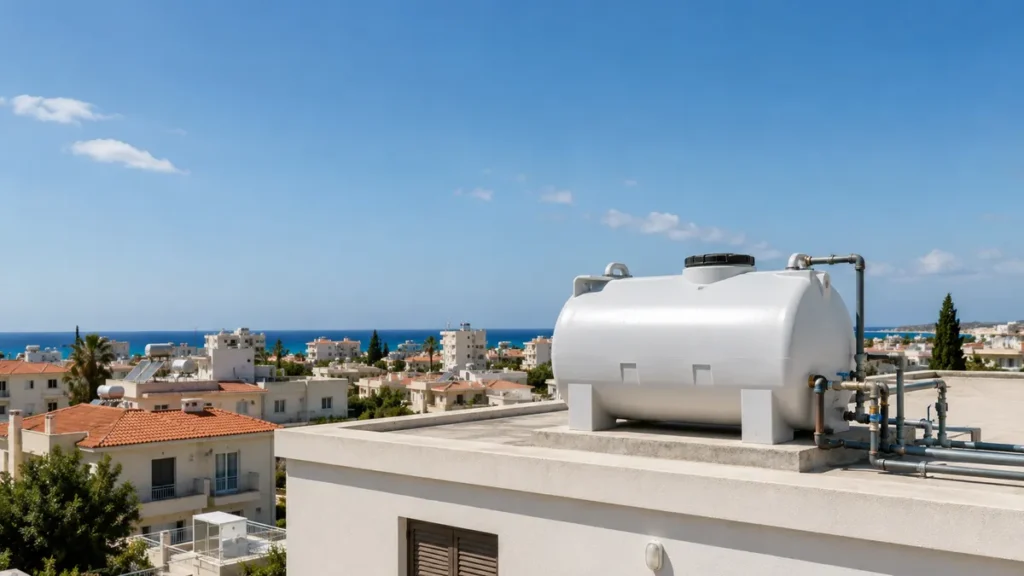
Legionella control should consider the complete building water system, including storage tanks, pipework and outlets.
What is Legionella?
Legionella is a bacterium found naturally in water that can multiply in building water systems under favourable conditions. People can develop Legionnaires’ disease when contaminated water droplets are inhaled or aspirated into the lungs. Water tanks, pipework, showers and stagnant sections of a water system can all be relevant to Legionella control.
- Water systems matter. Legionella can grow in engineered hot and cold water systems, including storage tanks, plumbing and outlets.
- Stagnation increases concern. Pipes with little or no water flow, sediment and biofilm can create favourable conditions for Legionella.
- Temperature matters. Cyprus Public Health identifies 20–45°C as a favourable temperature range for Legionella growth.
- Exposure is mainly through aerosols. Showers are an important example because they can produce small airborne water droplets that may be inhaled.
Official Cyprus information:
Cyprus Public Health Services — Legionellosis / Legionnaires’ Disease
What Is Legionella and Why Does It Matter in Cyprus?
Legionella is a group of bacteria found naturally in freshwater environments. The concern arises when the bacteria enter man-made water systems and find conditions that allow them to multiply. Water storage tanks, hot and cold water systems, pipework, taps and showers can all become relevant when water stagnates or other favourable conditions develop. Cyprus Public Health Services identifies water temperatures between 20°C and 45°C as particularly favourable for Legionella growth.
Legionella becomes a health risk when contaminated water is dispersed into small droplets or aerosols that can be inhaled or aspirated into the lungs. Showers are a common example, but other systems capable of producing aerosols can also create exposure. According to Cyprus Public Health Services, the infection is not considered to spread from person to person based on current scientific evidence.
Legionella and Legionnaires’ disease are not the same thing
These two terms are often used interchangeably, but they mean different things:
Legionella
The bacteria that can occur naturally in water and multiply within certain man-made water systems when conditions are favourable.
Legionnaires’ Disease
A potentially serious form of pneumonia caused by infection with Legionella bacteria after the bacteria reach the lungs.
Why is Legionella relevant in Cyprus?
Legionella is particularly relevant to water-system management. Cyprus Public Health Services lists hot and cold water storage tanks, taps, showers, low-flow pipework, water heaters, sediment and biofilm among environments where Legionella can survive or multiply under favourable conditions. It also identifies hotels, hospitals and clinics, schools, universities and care facilities among premises where potentially relevant water systems may be present.
The Cyprus Department of Labour Inspection has also issued guidance highlighting the risk associated with stagnant water systems, including taps and showers, and recommends measures such as addressing stagnant water and sampling water systems where appropriate.
For homeowners and building managers in Nicosia, Limassol, Larnaca and elsewhere across Cyprus, the important point is not to assume that clear-looking water or a clean storage tank automatically means the entire water system is free from Legionella. Legionella cannot be confirmed or ruled out by visual inspection alone; appropriate water sampling and laboratory analysis are needed when its presence must be determined.
Cyprus Public Health Services — Legionellosis / Legionnaires’ Disease ↗
European Centre for Disease Prevention and Control — Legionnaires’ Disease ↗
Where Does Legionella Grow in Water Systems?
Legionella can enter building water systems at low levels and multiply when conditions become favourable. The risk is influenced by several interacting factors, including water temperature, stagnation, water age, sediment, scale and biofilm. This means that the source of a Legionella problem may be a storage tank, but it may also be within the distribution pipework or at individual outlets.
For this reason, finding Legionella at a shower or tap does not automatically mean that the water storage tank is the source. The water system should be considered as a whole.
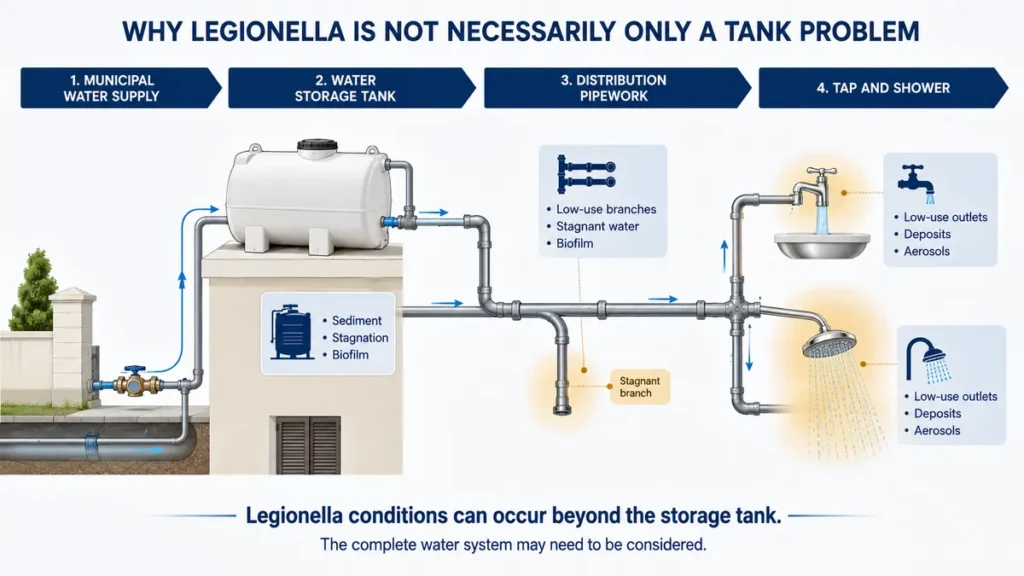
Legionella conditions can occur at different points in a building water system, from storage tanks to stagnant pipework and low-use outlets.
Water Storage Tanks
Water storage tanks can provide conditions favourable to Legionella when water remains stagnant for long periods or when sediment and biofilm accumulate.
The condition of the tank also matters. Poorly maintained covers, contamination entering the tank, accumulated sediment and insufficient water turnover can all reduce water hygiene.
Regular inspection and appropriate water tank cleaning and disinfection can therefore form an important part of water-system maintenance. However, cleaning the tank does not automatically disinfect downstream pipework, showers and other outlets.
Important: A clean water tank does not by itself prove that the rest of the building’s water system is free from Legionella.
Pipework and Stagnant Branches
Stagnation is one of the key conditions associated with Legionella growth. Water can remain in sections of pipework that are rarely used, oversized, isolated or no longer serving an actively used outlet.
- Rarely used bathrooms or guest rooms
- Unused taps and showers
- Redundant or poorly configured pipework
- Sections of a building that remain unoccupied
- Outlets with very low water use
Simply treating the storage tank may therefore fail to address contamination that is established farther downstream.
The
European Centre for Disease Prevention and Control
recommends regular flushing of taps and showers in unoccupied accommodation as part of Legionella risk reduction.
Showers, Taps and Low-Use Outlets
Showers are particularly relevant because they both contain water-system components where biofilm can develop and produce aerosols that can be inhaled.
Taps, showerheads, hoses and other outlets can also accumulate deposits and biofilm if they are not properly maintained.
Low-use outlets deserve particular attention. A shower that has not been used for an extended period can contain stagnant water even when the main storage tank is regularly replenished.
This is why Legionella prevention should consider the route water takes:
Storage → Distribution Pipework → Individual Outlet
rather than concentrating on only one component.
Temperature, Sediment and Biofilm
Temperature is another important factor. Cyprus Public Health Services identifies 20°C to 45°C as a favourable range for Legionella growth, while ECDC guidance recommends keeping cold water cold and hot water sufficiently hot as part of Legionella control.
Sediment and biofilm also matter. Biofilm is a layer of microorganisms and organic material that develops on wet internal surfaces, including inside pipes and tanks. It can provide an environment in which Legionella can persist and can make water-system control more difficult.
The combination of several conditions is therefore more important than any single factor:
🌡️ Favourable Temperature
Water within a temperature range that supports bacterial growth can increase the opportunity for Legionella to multiply.
🚰 Stagnant Water
Low-use outlets and sections of pipework can allow water to remain stagnant for extended periods.
🦠 Biofilm
Biofilm on internal wet surfaces can provide conditions that support Legionella persistence and growth.
◉ Sediment & Deposits
Sediment and other deposits can contribute to conditions that make microbial control more difficult.
Understanding where Legionella may be growing is important before deciding what corrective action is appropriate. If contamination is present within downstream pipework or outlets, treating only the storage tank may leave part of the problem unaddressed.
Cyprus Public Health Services — Legionellosis / Legionnaires’ Disease ↗
ECDC — Reducing Legionella Risk in Tourist Accommodation ↗
Can You Get Legionella from Showers or Drinking Water?
Legionella infection is mainly associated with breathing in small droplets of contaminated water or with contaminated water being aspirated into the lungs. This is why showers and other water systems that generate aerosols are particularly relevant when Legionella is present.
Simply drinking water containing Legionella is not considered the usual route of infection. However, aspiration can occur when water accidentally enters the lungs instead of travelling normally into the stomach, and some people are more vulnerable to infection than others.
Why Can Showers Be a Risk?
A shower produces a spray of very small water droplets. If Legionella has multiplied within the water system, contaminated droplets can become airborne around the person using the shower and may be inhaled.
The potential problem is not limited to the showerhead itself. Legionella may be associated with different parts of the system supplying it, including:
- The hot or cold water supply
- Water storage tanks
- Distribution pipework
- Flexible shower hoses
- Showerheads and other outlet components
- Sections of pipework where water has remained stagnant
This is also why an unused shower deserves attention. Water that remains stagnant in a branch of pipework for an extended period can create more favourable conditions for microbial growth, particularly when combined with suitable temperatures and biofilm.
The
European Centre for Disease Prevention and Control
recommends regular flushing of taps and showers in unoccupied tourist accommodation as one of its Legionella risk-reduction measures.
What About Drinking Water?
The distinction here is important:
💧 Drinking
Swallowing contaminated water is not the usual way Legionnaires’ disease develops. The bacteria need to reach the lungs to cause the infection.
🌫️ Inhaling Aerosols
Breathing in small contaminated water droplets is a recognised route of exposure. Showers are an important example.
🫁 Aspiration
Infection can also occur when contaminated water accidentally enters the lungs while drinking or swallowing.
Who Is More at Risk?
Not everyone exposed to Legionella develops Legionnaires’ disease. According to
Cyprus Public Health Services,
people at increased risk include older adults, smokers, people with chronic lung disease and people whose immune systems are weakened.
Have a positive Legionella result? Do not rely on the appearance, smell or taste of the water to judge whether the problem has been resolved. The result should be considered together with the sampling location and the condition of the building’s water system. For health advice following possible exposure or symptoms, contact a healthcare professional or the relevant public-health authority.
How Do You Know If Legionella Is in Your Water?
You cannot tell whether water contains Legionella simply by looking at it, smelling it or tasting it. Water may appear completely normal while Legionella is present somewhere within the water system. When its presence needs to be determined, appropriate samples must be collected and analysed microbiologically.
When Legionella needs to be investigated, appropriate samples must be collected and analysed microbiologically. Our Legionella testing in Cyprus guide explains sampling locations, laboratory analysis and how results should be understood.
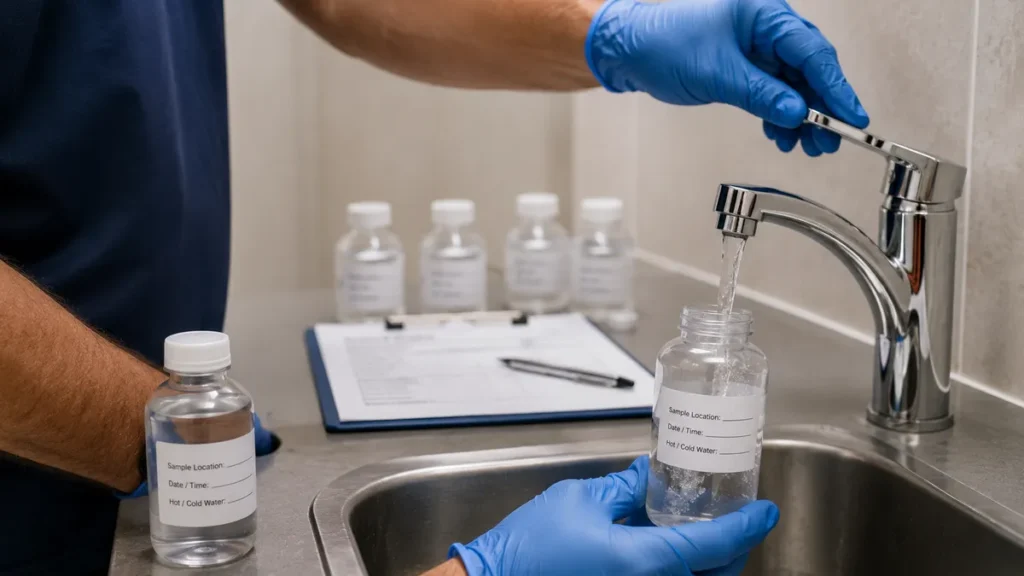
Determining whether Legionella is present requires appropriate water sampling and microbiological laboratory analysis.
A Legionella investigation is also about where samples are taken, not just whether a single sample is positive or negative. Depending on the building and reason for testing, relevant sampling points may include storage tanks, hot and cold water systems, showers, taps and other selected outlets.
How Is Water Tested for Legionella?
One recognised laboratory method is ISO 11731:2017 — Water quality — Enumeration of Legionella. The standard specifies culture methods for isolating Legionella and estimating the number present in water samples. It applies to potable and other types of water, as well as water-related materials such as biofilm and sediment.
Laboratory reports commonly express culture results as CFU/L (colony-forming units per litre). The result should be interpreted together with factors such as the sampling point, type of water system and reason for testing rather than treated as an isolated number.
Important: A negative result from one sampling point does not automatically prove that every part of a building’s water system is free from Legionella. Sampling locations should be selected according to the system and the purpose of the investigation.
Can a Water Meter Detect Legionella?
No. Ordinary field meters and
water measuring tools
cannot tell you whether Legionella bacteria are present.
Several measurements can still be useful when investigating or managing a water system:
🌡️ Temperature
Useful for assessing whether water temperatures may favour or help control Legionella growth. It does not detect the bacteria.
🧪 Disinfectant Residual
Chlorine or chlorine dioxide residual can help assess aspects of disinfection and water-system control. It does not prove that Legionella is absent.
💧 pH
pH is an important water-quality and treatment parameter, but it is not a Legionella test.
⚡ TDS / Conductivity
These measurements provide information about dissolved ions in the water. They cannot determine whether Legionella is present.
This means that a TDS meter, pH meter or chlorine/chlorine-dioxide measurement must not be presented as a Legionella test. Field measurements can support water-system assessment and treatment verification, but microbiological analysis is needed to determine the presence of culturable Legionella using the ISO 11731 approach.
What If You Already Have a Legionella Laboratory Result?
If you already have a laboratory report showing Legionella, keep the complete report, not just the positive number.
Useful information includes:
- The reported Legionella result and units
- The exact sampling location
- The date and time of sampling
- Whether the sample was from hot or cold water
- The laboratory method used
- Any additional information provided by the laboratory
A positive result from a storage tank and a positive result from a particular shower or tap can point to different questions about the water system. Understanding where the sample came from helps determine what should be investigated next.
Already Have a Legionella Test Result?
If your laboratory analysis has detected Legionella, send us the complete report together with the sampling locations. We can review the available water-system information with you and discuss appropriate next steps for the tank, pipework and affected outlets.
What If You Need Legionella Testing?
If you suspect a problem but do not yet have a laboratory result, appropriate microbiological testing is the correct way to determine whether Legionella is present.
Contact WaterFilterNet
to discuss appropriate laboratory testing options. We will not substitute ordinary water-quality measurements for microbiological Legionella analysis.
ISO 11731:2017 — Water Quality — Enumeration of Legionella ↗
What Should You Do If Legionella Is Found?
A positive Legionella result should be taken seriously, but the correct response depends on where the sample was taken, the level reported and the design and condition of the water system. Treatment should therefore begin with understanding the result and the affected system rather than automatically adding disinfectant to a water tank.
A positive sample from a storage tank, for example, presents a different investigation from a positive shower or tap when tank samples are negative. The objective is to identify where conditions are allowing Legionella to persist or multiply and then apply appropriate corrective measures.
If Legionella has already been detected, see our Legionella treatment in Cyprus guide for the corrective treatment process, including investigation, cleaning, disinfection and verification.
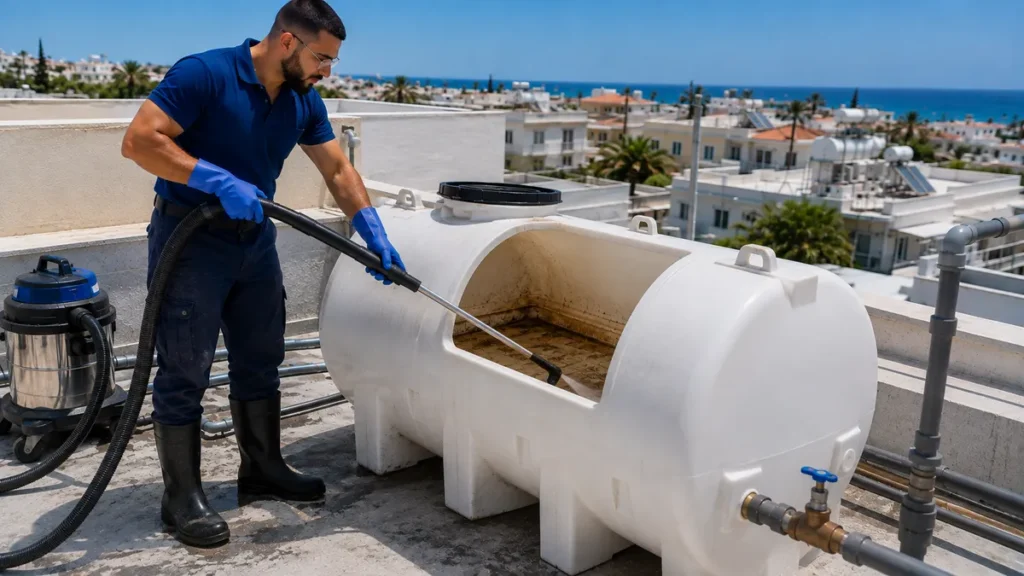
Cleaning sediment and contamination from a water storage tank can form part of corrective water-system hygiene work where required.
1. Review the Laboratory Result
Start with the complete laboratory report.
Important information includes:
- Legionella concentration and units, usually CFU/L
- Sampling location
- Sample date
- Hot or cold water
- Laboratory method
- Any species or serogroup information reported
- Results from other sampling points in the same building
Multiple results can be particularly useful because their pattern across the water system may help determine where further investigation is needed.
A single number should not be interpreted without knowing where and how the sample was collected.
2. Assess the Affected Water System
The next step is to understand the system supplying the positive sampling point.
Depending on the building, this may involve examining:
- Water storage tanks
- Hot and cold water distribution
- Pipework configuration
- Low-use or stagnant branches
- Showers and taps
- Sediment and visible contamination
- Temperature
- Disinfectant residual where relevant
- Recent periods of low occupancy or non-use
The aim is not simply to find something that can be disinfected. It is to understand why favourable conditions may have developed and which parts of the system require attention.
3. Choose Corrective Actions for the Actual Problem
There is no single corrective action that is appropriate for every Legionella result.
Depending on the findings, remedial measures may include:
🧹 Cleaning
Removing sediment and contamination from water storage tanks or other accessible components where cleaning is required.
🧪 Disinfection
Applying an appropriate disinfection method to the relevant parts of the water system under controlled conditions.
🚰 Flushing & Stagnation Control
Restoring water movement through low-use outlets and addressing sections of the system where water remains stagnant.
🔧 Corrective Maintenance
Addressing water-system conditions that may contribute to recurrence, where identified.
There is no universal Legionella treatment for every building. Established water-management guidance recognises measures such as cleaning, temperature control and disinfection, but the appropriate intervention depends on the water system and the conditions identified.
This is why tank cleaning alone should not automatically be described as Legionella treatment for an entire building. Where the tank itself requires attention, professional
water tank cleaning and disinfection
may form part of the corrective work, but downstream pipework and outlets may require separate measures.
4. Verify That the Corrective Action Worked
Completing a disinfection procedure is not the same as proving that Legionella has been controlled.
Field measurements such as temperature, pH or disinfectant residual can help confirm that treatment conditions were achieved. However, they do not detect Legionella.
Where microbiological verification is appropriate, follow-up laboratory sampling can provide evidence about whether the corrective measures have been effective.
Cleaning → disinfection → finished? Not necessarily. For a confirmed Legionella problem, verification is an important part of determining whether the corrective action achieved its intended result.
5. Reduce the Conditions That Allowed the Problem to Develop
A successful response should also consider why the problem occurred.
If stagnation, poor water turnover, sediment, unsuitable temperatures, neglected outlets or another system condition contributed to the problem, disinfection without addressing those conditions may leave an opportunity for the problem to recur.
For larger or more complex buildings, ongoing water-system management may therefore be required rather than relying only on one-off corrective treatment.
Technical reference:
CDC — Steps to Develop a Water Management Program ↗
Have You Received a Positive Legionella Result?
If a laboratory has detected Legionella in your water system, send us the complete laboratory report together with the sampling locations and results.
WaterFilterNet can review the available water-system information with you and discuss appropriate next steps, including tank cleaning, pipework and outlet considerations, disinfection and further testing where appropriate.
We do not assume that every positive Legionella result requires the same treatment.
📞 +357 99626069
[email protected]
Legionella Prevention in Cyprus — Frequently Asked Questions
Legionella prevention depends on managing the conditions that allow the bacteria to multiply within a water system. There is no single filter, chemical or one-off cleaning procedure that can guarantee a building will remain free from Legionella.
Good water-system management focuses on temperature, water movement, cleanliness, maintenance and identifying areas where water can stagnate.
For homes and buildings in Cyprus, practical measures may include:
🚰 Avoid Prolonged Stagnation
Identify low-use taps, showers and sections of pipework where water can remain unused for extended periods.
🌡️ Manage Water Temperatures
Temperature is an important Legionella control factor. Hot and cold water systems should be managed according to appropriate water-hygiene guidance and the design of the building.
🧹 Keep Water Systems Clean
Inspect and maintain tanks, outlets and other water-system components, and address sediment, deposits and contamination where found.
🔍 Check the Whole System
Do not assume that maintaining the storage tank alone addresses conditions within downstream pipework, showers and taps.
The
European Centre for Disease Prevention and Control
advises measures including maintaining appropriate hot and cold water temperatures, regularly flushing unused outlets and keeping water-system components clean. The exact control measures required depend on the building and water system.
Legionella Prevention in Cyprus Workplaces and Hotels
Legionella is not only a residential water issue. Larger and more complex water systems can require more structured management because they may contain extensive pipework, multiple storage points and outlets with different usage patterns.
On 8 July 2026, the Cyprus Department of Labour Inspection issued a specific announcement concerning the prevention and control of Legionella in workplaces and hotel establishments, highlighting the importance of appropriate preventive and control measures.
For employers and building operators, Legionella should therefore be considered as part of appropriate water-system and occupational safety management where the risk is relevant.
Official Cyprus information:
Department of Labour Inspection — Legionella Prevention and Control ↗
Note: The appropriate Legionella control measures depend on the building, water system and identified risks. A single treatment or maintenance action should not be treated as a guarantee against future Legionella growth.
What is Legionella and how do you get it?
Legionella is a bacterium that can multiply in man-made water systems when conditions are favourable. Legionnaires’ disease can develop when contaminated water droplets are inhaled or when contaminated water is aspirated into the lungs. It is not normally acquired simply through contact with water.
Can you get Legionella from showering?
Yes, exposure can occur through showers if the water contains Legionella, because shower spray produces small water droplets that can be inhaled. This does not mean that every shower presents a Legionella risk; the bacteria must be present and conditions within the water system influence whether they multiply.
Can unused showers increase the risk of Legionella?
Unused or rarely used showers can contribute to conditions favourable to Legionella because water may remain stagnant in the associated pipework. Regular flushing of low-use outlets can form part of an appropriate Legionella control programme.
What temperature allows Legionella to grow?
Cyprus Public Health Services identifies 20°C to 45°C as a favourable temperature range for Legionella growth. Temperature is therefore an important part of Legionella control, together with water movement, cleanliness and other water-system conditions.
How can you tell if Legionella is in your water?
You cannot reliably identify Legionella from the water’s colour, smell or taste. Microbiological laboratory analysis is required to determine whether Legionella is present. Ordinary TDS, pH, temperature or disinfectant-residual measurements cannot replace Legionella analysis.
Does cleaning a water tank remove Legionella from the whole system?
Not necessarily. Cleaning and disinfecting a contaminated storage tank can be an important corrective measure, but Legionella may also persist within downstream pipework, biofilm, showers or other outlets. The appropriate response depends on where contamination is present and the condition of the water system.
What should I do if my Legionella water test is positive?
Keep the complete laboratory report, including the result, units and sampling location. The affected water system should then be assessed so that appropriate corrective actions can be selected. Depending on the findings, these may include cleaning, flushing, disinfection, maintenance and follow-up laboratory testing.
How can Legionella be prevented in a building’s water system?
Prevention focuses on controlling the conditions that allow Legionella to multiply. This can include reducing stagnation, maintaining appropriate water temperatures, keeping tanks and outlets clean, maintaining the water system and monitoring relevant control measures. More complex buildings may require a structured water-management programme.
20+ Years Experience
Water treatment experience in Cyprus since 2000.
Whole-System Approach
Tanks, pipework and outlets considered where relevant.
Evidence-Based Guidance
Treatment decisions based on the water system and available results.
Local Cyprus Support
Nicosia, Limassol, Larnaca, Famagusta and surrounding areas.
Concerned About Legionella in Your Water System?
If you already have a Legionella laboratory report, send us the complete results together with the sampling locations. We can review the available water-system information and discuss appropriate next steps.
If you have not tested yet, contact us to discuss appropriate Legionella laboratory testing options and what information may be useful before sampling.
Serving restaurants, offices, businesses and homes across Cyprus since 2000.
📞 +357 99626069