
Legionella testing in Cyprus requires appropriate water sampling and microbiological laboratory analysis. Legionella cannot be confirmed from the appearance, smell or taste of the water, and ordinary field measurements such as TDS, pH, temperature or disinfectant residual do not detect the bacteria.
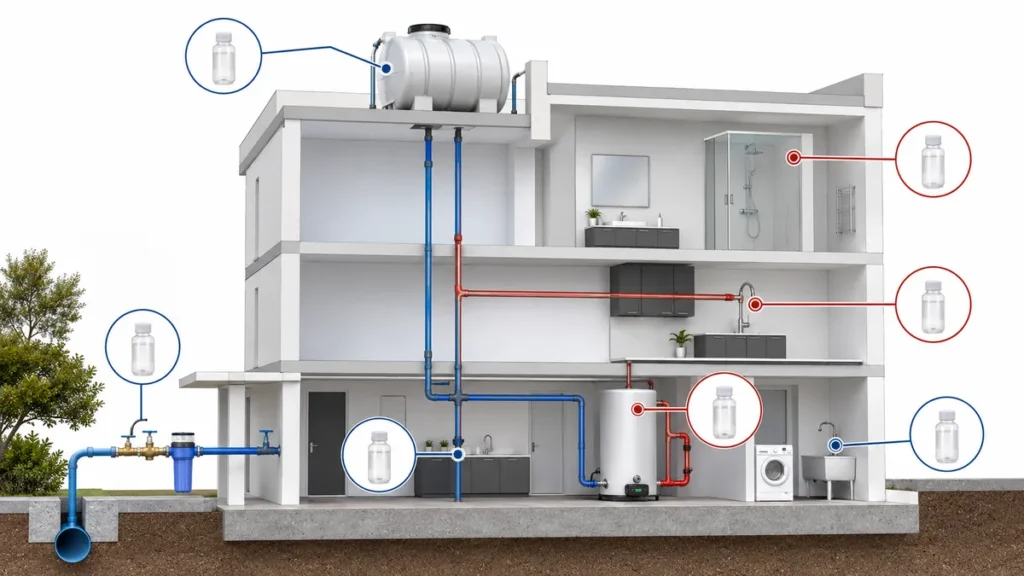
Correct testing is also about where samples are taken and why. Depending on the building and purpose of the investigation, relevant sampling points may include water storage tanks, hot and cold water systems, showers, taps and selected low-use outlets.
For a broader explanation of how Legionella develops in building water systems, exposure routes and prevention, see our
Legionella in Cyprus guide.
How is water tested for Legionella?
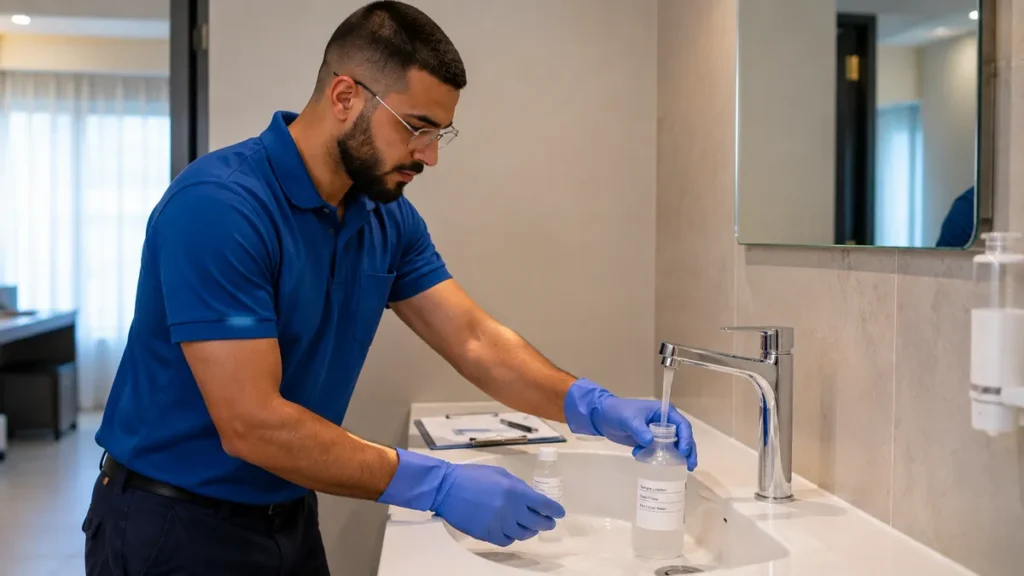
Legionella is determined through appropriate water sampling followed by microbiological laboratory analysis. ISO 11731:2017 is a recognised international standard describing culture methods for isolating Legionella and estimating the number of culturable bacteria present in water samples.
- Sampling location matters. A tank, shower and tap represent different points within the water system.
- Culture results are commonly reported in CFU/L. This means colony-forming units per litre.
- One sample does not represent every part of a building. Sampling points should reflect the purpose of the investigation.
- Ordinary water-quality meters do not detect Legionella. Field measurements can support an investigation, but they are not Legionella tests.
Technical reference:
ISO 11731:2017 — Water Quality — Enumeration of Legionella ↗
What Does a Legionella Water Test Actually Test?
A Legionella water test looks for Legionella bacteria in a water sample using microbiological laboratory methods.
For culture-based analysis, the laboratory processes the sample under controlled conditions so that culturable Legionella can be isolated and enumerated.
The result is commonly reported as CFU/L — colony-forming units per litre. This provides an estimate of the concentration of culturable Legionella detected under the conditions of the laboratory method.
Laboratory Legionella Analysis vs Ordinary Water Testing
Different measurements answer different questions about a water system.
🦠 Legionella Laboratory Analysis
Determines whether culturable Legionella is detected in the submitted sample and, where applicable, estimates its concentration in CFU/L.
🌡️ Temperature
Helps assess water-system conditions and temperature control. It does not detect Legionella.
🧪 Disinfectant Residual
Can help monitor aspects of a disinfection or control programme. It does not prove that Legionella is absent.
💧 pH / TDS / Conductivity
Describe chemical or physical characteristics of the water. They are not microbiological Legionella tests.
Important: A handheld water-quality meter cannot tell you whether Legionella is present. Water measuring tools can support investigation and monitoring, but Legionella requires appropriate microbiological laboratory analysis.
What Does ISO 11731 Measure?
ISO 11731:2017 — Water quality — Enumeration of Legionella specifies culture methods for isolating Legionella and estimating their numbers in water samples. The standard can also apply to water-related matrices such as biofilms and sediments.
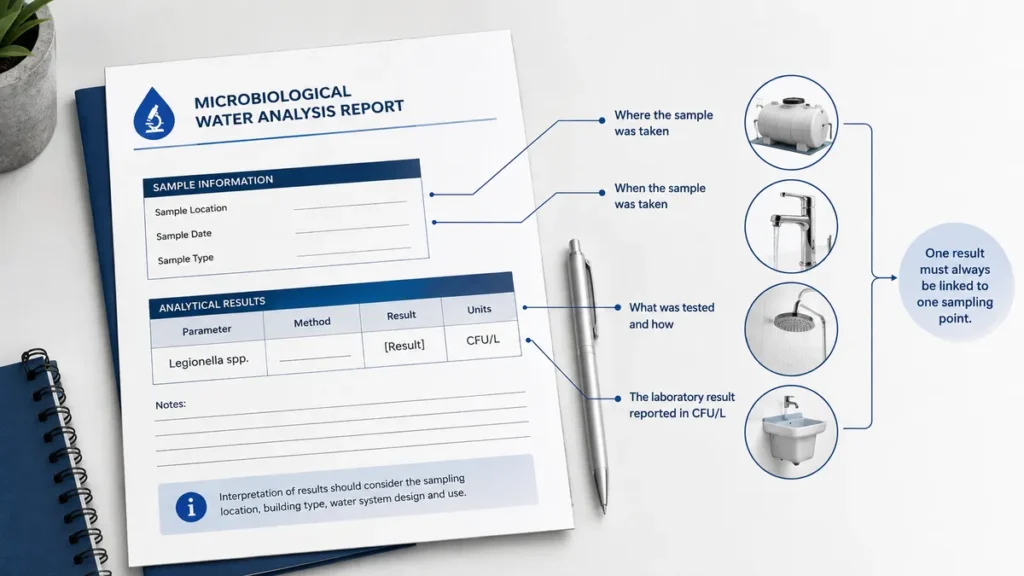
A culture-based laboratory report may contain information such as:
Parameter: Legionella spp.
Method: ISO 11731:2017
Result: [reported value] CFU/L
Sampling point: [tank / tap / shower / other outlet]
A Legionella result tells you what was detected in the submitted sample. By itself, it does not identify where the problem originated or describe every other part of the building’s water system.
Where Should Legionella Water Samples Be Taken?
Legionella sampling points should be selected according to the water system and the reason for testing. There is no single location that is automatically correct for every home, hotel, office or other building.
A sample from a storage tank answers a different question from a sample taken at a shower or tap. The objective is to select locations that provide meaningful information about the areas being investigated.
Key point: Legionella testing is not simply about taking water from the easiest tap. The sampling strategy should reflect what you are trying to understand about the water system.
Water Storage Tanks
Water storage tanks may be relevant sampling locations, particularly where there are concerns about stagnation, sediment, water turnover or tank condition.
A tank result, however, applies to that sampled location. A negative tank result does not automatically rule out Legionella farther downstream in pipework, showers or taps. Likewise, a positive tank sample does not by itself show whether every downstream outlet is affected.
Showers and Taps
Showers and taps can be important sampling points because they represent the water reaching outlets used by building occupants. Showers are particularly relevant to Legionella investigations because they can generate airborne water droplets.
Depending on the investigation, appropriate outlets may include:
- Frequently used showers or taps
- Rarely used outlets
- Outlets in different parts of the building
- Locations supplied by different tanks or water circuits
- Sites associated with a previous positive result
- Points suspected of prolonged stagnation
Hot and Cold Water Systems
Where a building has separate hot and cold water distribution, it may be important to understand which part of the system is being investigated.
Cyprus Public Health Services identifies temperatures of approximately 20°C to 45°C as favourable for Legionella multiplication. Relevant sampling locations may therefore include storage, hot-water systems, cold-water systems and representative outlets.
Cyprus reference:
Cyprus Public Health Services — Legionellosis / Legionnaires’ Disease ↗
Low-Use and Problem Outlets
Low-use outlets can be particularly informative. Water remaining within a branch of pipework for prolonged periods can experience different conditions from frequently used parts of the same building.
Examples may include:
- Unused or rarely used showers
- Guest bathrooms with little use
- Seasonally occupied rooms
- Vacant offices or apartments
- Remote outlets at the end of distribution runs
- Areas reopened after an extended closure
How Many Legionella Samples Are Needed?
There is no universal number that is correct for every building. The number and location of samples should reflect the size and complexity of the water system, the purpose of testing and any known problem areas.
🔍 Investigating a Concern
Sampling can focus on points that help establish whether Legionella is detected and where further investigation may be useful.
🧪 Investigating a Positive Result
Additional locations can help establish whether a finding appears localised or is also detected elsewhere.
✓ Verifying Corrective Work
Follow-up samples may form part of evaluating a system after appropriate corrective measures.
Avoid random sampling: More samples do not automatically mean a better investigation. The goal is to select points that answer meaningful questions about the water system.
How Is Legionella Sampling and Laboratory Analysis Carried Out?
Legionella testing involves more than filling a bottle with water and sending it to a laboratory. The process should begin by defining the purpose of testing, followed by selecting suitable sampling points, collecting and transporting the samples correctly, laboratory analysis and interpretation of the results.
1. Plan
Define the reason for testing and what parts of the system need to be represented.
2. Sample
Collect water from selected locations using the required containers and sampling procedure.
3. Analyse
The laboratory performs the applicable microbiological analysis.
4. Interpret
Review the results together with the sampling points, system and reason for testing.
1. Define the Purpose and Sampling Plan
Before samples are collected, identify what the testing is intended to answer. This might be investigation of a suspected problem, assessment following a positive result, testing of selected tanks or outlets, or verification following corrective work.
The objective determines which sampling locations will provide useful information. Testing one particular shower is different from investigating conditions across a large building with multiple tanks and distribution branches.
2. Collect the Samples Correctly
Samples should be collected according to the procedure required for the investigation and laboratory analysis. The sample container, collection conditions and information recorded can influence what the sample represents.
The laboratory or competent sampling provider should confirm requirements such as:
- Suitable sterile sampling containers
- Required sample volume
- Sampling conditions
- Identification of each sampling point
- Relevant observations or measurements
- Storage and transport requirements
- Required time between sampling and laboratory processing
Important: Do not collect a Legionella sample in an ordinary household bottle and assume it will be suitable for the intended laboratory investigation. Containers, collection, transport and documentation should follow the laboratory’s requirements.
3. Identify and Transport the Samples
Each sample should remain clearly connected to its sampling location. This is particularly important when several samples are taken from one property.
A laboratory result identified only as “water” provides far less useful information than one that can be traced to a clearly defined tank, shower, tap or other outlet.
4. Laboratory Analysis
For culture-based testing, the laboratory processes and incubates the sample under controlled conditions to isolate and enumerate culturable Legionella. This is why culture analysis is not an immediate test like a handheld meter reading.
Technical reference:
ISO 11731:2017 — Water Quality — Enumeration of Legionella ↗

5. Review the Laboratory Report
The report should allow each result to be connected to the submitted sample. Depending on the laboratory and analysis performed, useful information may include:
- Sample identification and sampling location
- Date of sampling and/or receipt
- Parameter analysed
- Analytical method
- Result and units
- Additional laboratory comments where applicable
The laboratory number is important, but the next question is what that result means for the location sampled and the wider water system.
How Should a Legionella Test Result Be Understood?
A Legionella laboratory result should not be interpreted from the number alone. The concentration matters, but so do the sampling point, water system, reason for testing, laboratory method and other available results.
What Does CFU/L Mean?
CFU/L means colony-forming units per litre. In culture-based Legionella analysis, it expresses the estimated concentration of bacteria capable of forming colonies under the test conditions.
The result should therefore remain connected to the specific sample and sampling location from which it came.
What Does “Legionella spp.” Mean?
“Legionella spp.” refers to species within the Legionella genus. The level of identification provided can vary according to the analysis performed and how the laboratory reports its findings.
A report may also contain more specific identification, such as Legionella pneumophila, where applicable. The actual laboratory method and reported findings should therefore be reviewed rather than assuming all Legionella reports provide identical information.
What Does a Positive Result Mean?
A positive culture result means that culturable Legionella was detected in the submitted sample under the laboratory test conditions.
It does not, by itself, establish:
- Where else in the building Legionella may or may not be present
- The exact reason the bacteria developed
- Whether contamination is confined to one outlet
- Whether the storage tank is the source
- Which corrective action is appropriate for the entire system
Those questions require the result to be considered alongside the sampling location and the condition and design of the water system.
Does a Negative Result Mean the Whole Building Is Legionella-Free?
No. A negative result applies to the sample analysed and should not automatically be extended to the entire building.
Conditions can differ considerably between a frequently used tap, a distant shower, storage tank, stagnant branch or rarely used outlet. If the objective is to understand a wider system, representative sampling locations may therefore be required.
Avoid “Legionella-free” claims: Negative samples do not establish that Legionella can never be present elsewhere in a complex system or cannot develop again if conditions become favourable.
Is There a Safe Legionella CFU/L Level?
A Legionella result should not be reduced to a universal “safe versus dangerous” number. Interpretation depends on the applicable regulatory or technical framework, the type of premises and water system, the sampling location, the reason for testing and the people potentially exposed.
For context, Directive (EU) 2020/2184 specifies a Legionella parametric value of <1,000 CFU/L for the risk assessment of domestic distribution systems. The Directive also states that action may be considered even below this value in circumstances such as infections or outbreaks.
This does not mean: “below 1,000 CFU/L is always safe” or “above 1,000 CFU/L automatically defines the same level of risk in every situation.” The result must be considered in its proper context.
European reference:
Directive (EU) 2020/2184 — Quality of Water Intended for Human Consumption ↗
Why Can Results Differ Across the Same Building?
The pattern of results from different locations can sometimes provide more information than a single value.
| Sampling Point | Illustrative Finding | Question It Raises |
|---|---|---|
| Storage Tank | Not detected | Could conditions differ farther downstream? |
| Frequently Used Tap | Not detected | What is happening in other branches or low-use outlets? |
| Low-Use Shower | Detected | Could local stagnation, the outlet or associated pipework require investigation? |
The example above is illustrative only. It is not a laboratory result, regulatory threshold or diagnostic rule.
Already Have a Legionella Laboratory Result?
Send us the complete laboratory report rather than only the CFU/L number. If the sampling locations are not clearly identified, include that information as well. We can review the available water-system information with you and discuss appropriate next steps.
When Should Legionella Testing Be Considered?
Legionella testing may be appropriate when there is a defined reason to investigate a water system, verify corrective work or support an appropriate water-hygiene programme. Whether testing is required — and where samples should be collected — depends on the premises, water system and circumstances.
After Legionella Has Already Been Detected
Where Legionella has been detected at one sampling point, further testing may help establish whether the finding appears localised or whether Legionella is also detected elsewhere in the system.
For example, a positive shower sample does not automatically establish that a water storage tank is contaminated, while a negative tank sample does not automatically exclude downstream contamination.
If a laboratory result is positive and corrective work is required, our Legionella treatment in Cyprus guide explains how the water system can be investigated, treated and verified after corrective action.
After Cleaning, Disinfection or Other Corrective Work
Follow-up laboratory testing may form part of verifying the outcome of corrective measures following a Legionella finding.
Corrective work may involve cleaning, disinfection, flushing, maintenance or addressing conditions that contribute to stagnation. Where water storage tanks require physical cleaning and disinfection, our existing water tank cleaning and disinfection service addresses the tank itself; wider Legionella investigation may also need to consider downstream pipework and outlets.
The appropriate timing and sampling locations for follow-up testing should reflect the treatment carried out, the water system and the objective of the investigation.
Important: Measuring disinfectant residual after treatment can help verify aspects of the disinfection process, but it is not a substitute for Legionella laboratory analysis.
After Extended Stagnation or Low Water Use
Periods of low water use can create conditions that favour Legionella growth. Testing may therefore be considered as part of an investigation where a building or section of a building has experienced prolonged stagnation or substantially reduced use.
Examples include seasonally occupied accommodation, vacant offices or apartments, rarely used bathrooms and areas reopened after an extended closure.
Testing does not replace addressing stagnation itself. Water-system management may also require restoring appropriate water movement, flushing, maintenance or correction of underlying plumbing conditions.
Workplaces, Hotels and More Complex Water Systems
Larger buildings can contain water storage tanks, extensive pipework, numerous outlets and areas with very different patterns of water use.
In Cyprus, the Department of Labour Inspection issued an announcement on 8 July 2026 specifically concerning Legionella prevention and control in workplaces and hotel establishments. It highlighted the importance of appropriate prevention and control measures.
For hotels, offices and other workplaces, testing is therefore best considered within the wider management of the building water system rather than as an isolated laboratory exercise.
Cyprus reference:
Cyprus Department of Labour Inspection — Legionella Prevention and Control ↗
Does Every Home Need Routine Legionella Testing?
Not necessarily. Legionella testing should have a clear purpose. Routine sampling of every home simply because it has a water storage tank would not automatically provide useful information or replace appropriate system maintenance.
Testing may be worth discussing where there is a previous positive result, significant stagnation, unusual water-system conditions or another specific reason for investigation.
Testing Is Only One Part of Legionella Control
A laboratory test provides valuable microbiological information, but testing alone does not control Legionella.
Effective water-system management focuses on the conditions that allow Legionella to multiply or persist. Depending on the system, this can involve temperature, stagnation, water storage, pipework, outlets, cleanliness, maintenance, disinfection and appropriate ongoing control measures.
Legionella Testing in Cyprus — Frequently Asked Questions
These are some of the most common questions about Legionella water sampling, laboratory analysis and interpreting results in Cyprus.
How do you test water for Legionella?
Legionella testing requires appropriate water sampling followed by microbiological laboratory analysis. Sampling points should be selected according to the water system and reason for testing. Culture-based methods such as ISO 11731:2017 can be used to isolate and enumerate culturable Legionella in water samples.
Can I test for Legionella with a water-quality meter?
No. TDS, conductivity, pH, temperature and disinfectant-residual measurements can provide useful information about water-system conditions, but they do not determine whether Legionella is present. Appropriate microbiological laboratory analysis is required.
Where should Legionella water samples be taken?
Sampling points depend on the building, water system and purpose of the investigation. Relevant locations may include storage tanks, hot and cold water systems, showers, taps and selected low-use outlets. The locations should be chosen to answer meaningful questions about the system.
How many Legionella samples should be taken?
There is no universal number suitable for every building. The number and location of samples depend on the size and complexity of the water system, the reason for testing and any known problem areas.
What does CFU/L mean on a Legionella test?
CFU/L means colony-forming units per litre. In culture-based Legionella analysis, it expresses the estimated concentration of culturable bacteria detected under the laboratory test conditions. The result should be interpreted together with the sampling point, method and wider water-system context.
Does a negative Legionella test mean the whole building is safe?
A negative result applies to the sample analysed and should not automatically be taken to mean that Legionella is absent from every part of the building. Conditions may differ between tanks, pipework, showers, taps and low-use outlets.
How long do Legionella laboratory results take?
Turnaround time depends on the laboratory and analytical method. Culture-based Legionella analysis requires laboratory processing and incubation, so results are not immediate. The expected reporting time should be confirmed when the analysis is arranged.
When should Legionella be retested after cleaning or disinfection?
Follow-up testing may be appropriate after corrective work, but there is no single retesting time that applies automatically to every situation. Timing and sampling locations should reflect the treatment carried out, the water system, the reason for testing and applicable laboratory or technical guidance.
How can I check whether a laboratory is accredited for Legionella testing?
Ask whether the laboratory holds ISO/IEC 17025 accreditation and whether the relevant Legionella analysis is included within its accredited scope. General laboratory accreditation does not necessarily mean that every test performed by the laboratory is covered by that accreditation. The applicable method and accredited scope should therefore be confirmed with the laboratory.
20+ Years Experience
Water treatment experience in Cyprus since 2000.
Sampling With a Purpose
Testing should answer meaningful questions about the water system.
Laboratory-Based Testing
Legionella requires appropriate microbiological laboratory analysis.
Local Cyprus Support
Nicosia, Limassol, Larnaca, Famagusta and surrounding areas.
Serving restaurants, offices, businesses and homes across Cyprus since 2000.
Need Legionella Testing in Cyprus?
Whether you need to investigate a water tank, shower, tap or wider building water system, contact us to discuss appropriate Legionella sampling and laboratory testing. If you already have laboratory results, send us the complete report and sampling locations.
📞 +357 99626069